

Quick answer: For a dishwasher not cleaning top rack dishes, start with loading, an obstructed upper spray arm, blocked jets, the rack’s water connection and overall water circulation. The symptom does not prove that one component failed. Confirm the arms can rotate with the racks loaded, then follow the manual for any removable filter or spray-arm cleaning.
Key Takeaways
- The split between racks is the diagnosis. The lower arm is working, the upper one is not.
- Blocked upper-arm jets are one useful check, alongside loading, the rack connection and overall circulation.
- A tall item in the bottom rack stopping the arm turning is the second.
- Clean the main filter too. Low pressure reaches the top rack last.
A dishwasher top rack not getting clean often leads to the dishwasher upper spray arm as a first check. Whirlpool, properly loading a dishwasher supports checking spray-arm clearance and following the model’s rack arrangement, but a top-rack symptom alone does not prove the failed part.
Dishwasher Not Cleaning Top Rack: Why a dishwasher not cleaning the top rack is a spray problem
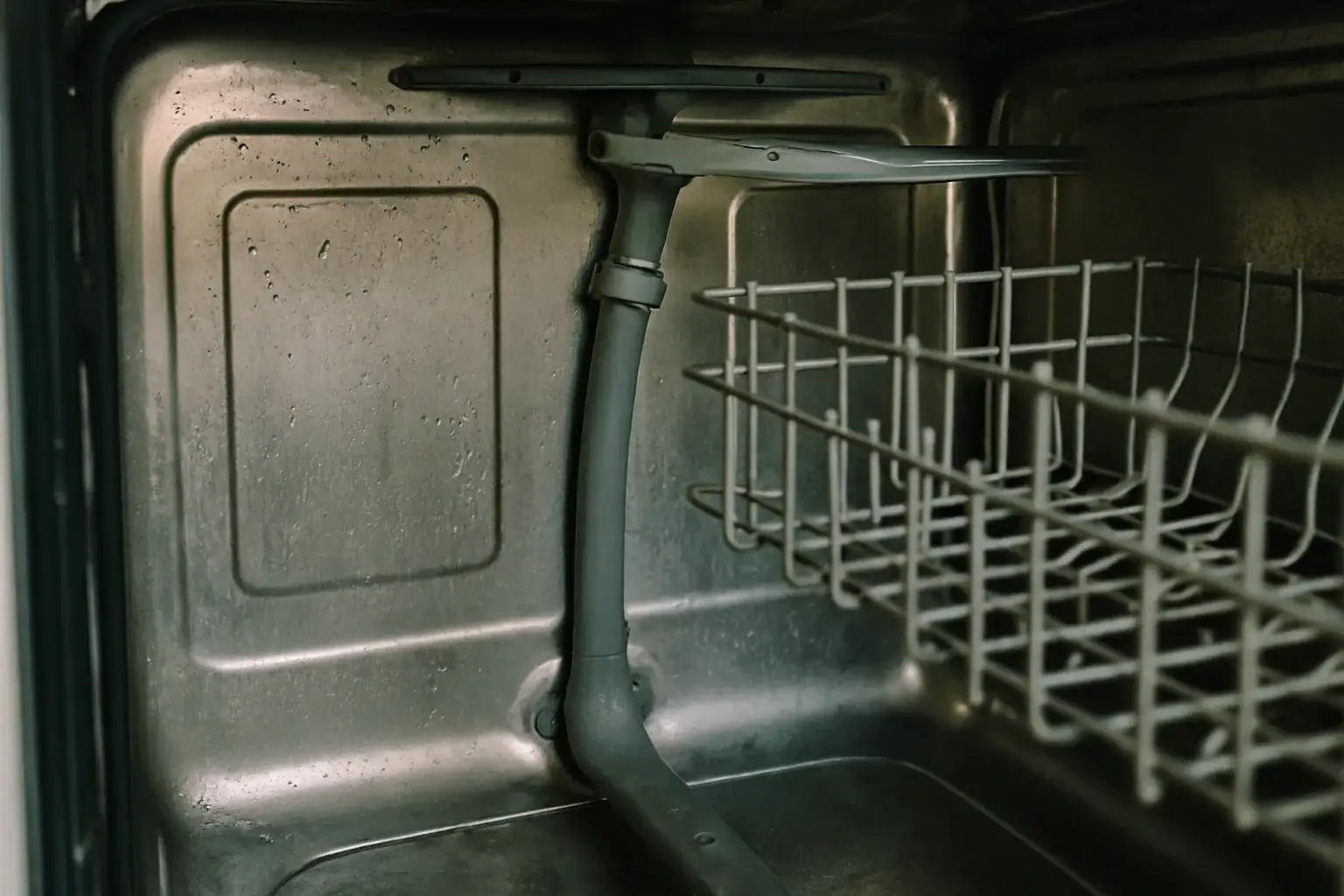
A dishwasher pumps water to two or three spray arms. The lower arm sits under the bottom rack and is fed directly. The upper arm is fed through a tube running up the back or side of the tub, and often through a fitting in the rack itself.
That longer path is why the top rack fails first. Anything that reduces pressure or blocks flow shows up there while the bottom rack keeps washing normally.
Which is useful, because a load where both racks are dirty points at detergent, water temperature or the pump, and a load where only the top rack is dirty points at the upper arm circuit specifically.
The upper spray arm
Remove a spray arm only when the owner’s manual provides the method. Fasteners and rack connections vary, and forcing a plastic fitting can create a new leak or cleaning problem.
Hold it under a hot tap and run water backwards through it so it comes out of the jets. Seeds, grit, bits of label and limescale block the small angled holes, and a blocked jet takes out a whole sector of the wash pattern.
Clear stubborn holes with a toothpick or a piece of stiff wire. Do not use a needle or anything that could enlarge the hole, since that changes the spray pattern permanently.
After model-approved cleaning, refit the arm as documented and confirm that loading does not block rotation.
Something is fouling the arm
This is worth checking every time, because it is invisible once the door is shut.
Load the machine as you normally would, then reach in and spin the upper arm by hand through a full rotation. A tall glass, a serving spoon poking up through the top rack, or a pot handle in the bottom rack will stop it dead. The arm then either does not turn at all or only sweeps part of the way.
The same check applies to the lower arm, spun with the bottom rack loaded.
If items are consistently in the way, the rack height may be adjustable. Many top racks can be raised or lowered on side clips.
The feed tube and the rack coupling
Follow the path water takes up to the arm. On most machines that is a plastic tube up the back wall of the tub, sometimes ending in a coupling that engages with the top rack when it is pushed fully in.
Two things go wrong. The tube blocks with grease and debris, which needs it disconnecting and flushing. Or the rack is not pushed fully home, so the coupling does not seat and water sprays into the tub instead of into the arm.
That second one is trivial and it catches people. Push the top rack right in before closing the door, and if the rack height was recently adjusted, check both sides are on the same setting. A rack sitting crooked will not couple properly.
Narrow it down
| What you see | Possible check |
|---|---|
| Top rack dirty, bottom rack cleaner | Loading, upper spray arm, rack connection or circulation |
| One area of the rack dirty | Blocked spray path or loading |
| Both racks dirty | Filter, detergent, fill, heat or circulation |
| Problem began after rack adjustment | Confirm the rack engages as the manual shows |
Do not skip the main filter
A partly blocked filter reduces the volume of water the pump can move, and the upper arm feels that before the lower one does. It also recirculates grit, which is what leaves a sandy deposit on upturned cups.
Twist the filter tower out from the floor of the tub, lift the mesh screen beneath it, rinse both under hot water and scrub the mesh. Refit and make sure the tower locks. The rest of the routine is in how to clean a dishwasher.
Loading the top rack
Bowls and cups face down and angled, not flat. Flat means a puddle sits in the base and nothing rinses.
Tall glasses go between the tines rather than over them, so water can get inside. Anything with a narrow neck is a poor candidate for a dishwasher at all.
Do not nest items. Two bowls stacked shield each other completely, and it looks like a machine fault.
Leave a gap in the middle so the upper arm has a clear sweep.
When it is a fault
Everything above is free. Past that point, a few things need a technician: a cracked or split feed tube losing pressure into the tub, a worn pump that no longer generates enough pressure to reach the top, or a diverter valve that alternates flow between the arms and has failed on one position.
A diverter or circulation fault is one possibility when loading, filters, spray arms and rack connections check out. The symptom is not conclusive without testing.
When you book, leave the machine as it is and do not pull it out of the cabinet first. A fault still present when the technician arrives usually gets sorted in one visit.
Frequently asked questions
Should the upper arm spin fast?
It spins in bursts as pressure alternates on many machines. What matters is that it turns freely by hand and is not blocked.
Why did this start suddenly?
Usually a single blocked jet, a rack height change, or a new large item in the load that fouls the arm.
Could it be detergent?
If both racks are dirty, broaden the checks to loading, detergent, fill, heat, filters and circulation. A top-rack-only result narrows the inspection but does not prove a mechanical failure.
Is there a third spray arm?
Some taller machines have a small one in the roof for the cutlery tray. It blocks the same way and gets cleaned the same way.
Would hard water do this?
Over time yes, by scaling up the jets. That is the same limescale a monthly acidic clean removes.
Where to go from here
Related: a dishwasher not cleaning properly, film and spots on dishes, a pod that will not dissolve and a dishwasher that will not dry.
For a pump, diverter or feed tube fault, book dishwasher repair in Winnipeg.
Need a diagnosis in Winnipeg? Call (431) 813-3999 or book a visit online. Diagnosis is $95 in Winnipeg and $120 outside the city. If you approve the repair, the quoted repair price includes the diagnostic visit.


