

Quick answer: A washing machine staining clothes can have several causes, and the colour of a mark does not prove one of them. Detergent or softener residue, soil inside the dispenser or door seal, a foreign metal object, water quality and a mechanical fault can produce overlapping symptoms. Stop using the washer if there is oil, metal damage or leaking water; otherwise, begin with the model’s cleaning and dosing instructions.
Key Takeaways
- Black flecks can come from soil or growth around a seal or dispenser, but inspect the machine before identifying the material or replacing a part.
- Grey smears mean too much detergent or softener, not too little.
- Rust spots on a stainless drum usually come from something metal left in the machine, not the drum itself.
- Dark oily streaks that appear alongside a rumbling noise are a bearing seal, and that is a real fault.
Black marks on clothes from a washer and a washing machine leaving marks need observation, not diagnosis from colour alone. LG, washer detergent residue troubleshooting identifies detergent type, amount, loading and cleaning as separate residue factors and directs owners back to the product instructions.
Washing machine staining clothes? Match the mark to the cause
What the marks mean
| What you see | Possible cause to investigate |
|---|---|
| Grey or white residue | Detergent, softener, loading or rinsing |
| Dark flecks | Soil in the seal or dispenser; inspect before assuming mould |
| Orange or brown spots | Foreign metal, water quality or damaged coating |
| Oily streaks | Stop and arrange diagnosis |
| Snags or pulls | Inspect the drum and load for a sharp object |
Black flecks: mould
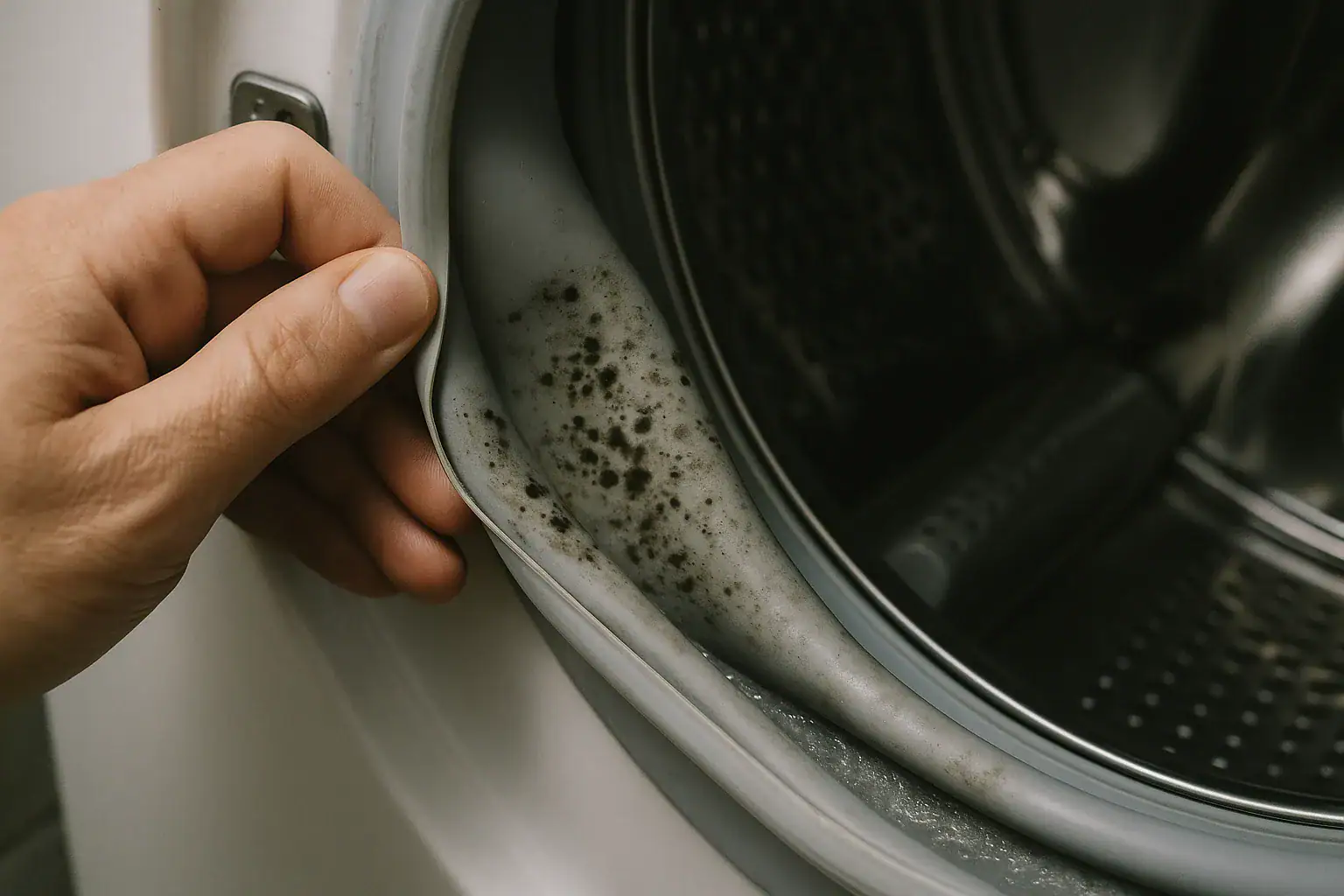
Dark residue in a front-loader door seal is one possible source, but appearance alone cannot confirm mould or exclude detergent, soil and transferred debris.
Pull the rubber boot back and look into the fold at the bottom. Black spotting, grey sludge and a musty smell mean you have found it. Fragments break loose during the wash and redeposit on the laundry, and they show worst on light-coloured cotton.
Clean the seal, dispenser and any user-serviceable filter with the products and cycle named in the owner’s manual. Do not mix cleaners or substitute vinegar when the manufacturer does not approve it.
Where the mould has grown into the pores of the rubber, cleaning improves it for a few weeks and then it comes back. At that point the gasket is a replacement part, and it is a routine job.
The habit that prevents it returning is leaving the door and the drawer open between washes.
Grey smears: too much soap
High-efficiency washers require the correct detergent type and dose for the model, load and water conditions.
Excess detergent does not rinse away. It builds into a waxy film in the drum and the outer tub, then transfers onto fabric as a grey or white smear that looks like grease. Fabric softener does the same thing and is worse, because it is designed to cling.
Use the dose on the detergent and appliance instructions, then run only the model-approved cleaning cycle or product. Rewash affected clothing according to its care label.
Detergent performance depends on its formula, dose, water conditions and selected cycle. Follow the label rather than applying one temperature rule to every load.
Orange and brown: rust
Possible sources include a foreign metal object, the water supply and a damaged coated component. Their likelihood depends on the pattern and inspection.
Something metal left in the drum. A hairpin, a coin, a screw or a paperclip left sitting in a damp drum for a week leaves a rust mark exactly where it rested. Check the drum before and after loads.
Iron in the water supply. Well water and some older plumbing carry enough iron to stain laundry, and it usually shows up on whites across a whole load rather than as discrete spots. A rust-removing laundry additive and a water test tell you quickly.
The drum itself. Stainless steel drums do not rust in normal use, but a chipped enamel or painted component, a rusting spider arm behind the drum, or a corroded balance weight can. If the marks recur with a clean drum and clean water, that is worth looking at.
Blue and purple streaks
Concentrated liquid detergent or softener poured straight onto clothes rather than into the dispenser. Modern concentrates are strongly dyed and they stain on contact before the water disperses them.
Use the dispenser drawer. If your machine does not have one for liquid, use a dosing ball placed in the drum before the clothes go in, not on top of them.
Rewashing without detergent usually lifts it.
Dark oily streaks: this one is a fault
Greasy dark marks, especially alongside a rumbling or grinding noise during the spin, point at the outer tub seal failing and letting lubricant past the drum bearings.
It arrives with the other bearing symptoms: noise that has been getting worse over months, and eventually water appearing under the middle of the machine during the spin. Those are covered in a washing machine that is loud or shaking and a leaking washing machine.
Stop using the machine for anything you care about, because it will keep marking clothes. This is a real repair, and on an older machine it is one of the cases where replacement can make more sense. We will tell you which situation you are in.
Snags rather than stains
Pulls, snags and small tears are mechanical rather than chemical. Run a hand carefully around the inside of the drum feeling for a burr, a lifted edge on a lifter, or a crack. Something sharp that has worked through from the outer tub, underwire being the usual culprit, will do this.
Do not keep washing delicates in a machine that is snagging. Get it looked at.
Frequently asked questions
Will a clean fix it?
For mould flecks, detergent smears and softener build-up, yes. For rust from the drum or a bearing seal, no.
How do I get the marks out of the clothes?
Rewash with no detergent to rinse out residue. For mould flecks, an oxygen bleach soak. For rust, a rust-specific laundry treatment, since chlorine bleach sets rust rather than removing it.
Why only on light clothes?
Everything shows more on light cotton. The marks are on the dark items too, and they are simply invisible.
Could it be the dryer instead?
Possible. Check whether the marks are there when the laundry comes out of the washer, before it goes in the dryer. A dryer drum with a scorched or rusted patch marks clothes the same way.
Is fabric softener worth using at all?
It builds up in the machine, reduces towel absorbency and feeds the biofilm behind most washer smells. Plenty of people stop using it and do not miss it.
Where to go from here
Related: a washing machine that smells, which shares the mould cause, cleaning the drain filter, and five ways to avoid the most common washing machine repairs.
For a seal, bearing or drum fault, book washer repair in Winnipeg.
Need a diagnosis in Winnipeg? Call (431) 813-3999 or book a visit online. Diagnosis is $95 in Winnipeg and $120 outside the city. If you approve the repair, the quoted repair price includes the diagnostic visit.


